Organizing teams for Z DevOps
When it comes to organizing teams for Z DevOps, each organization may have its own specific makeup of which skills come from which teams. However, generally speaking, the roles introduced in the Roles section can be considered in two groupings:
- a core Z DevOps team with representation from roles that are primarily impacted by and/or will drive the Z DevOps transformation project, and
- a supporting group of teams and roles that help facilitate the transformation and may also be impacted by it, even if not to the same degree as the core team.
The following sections detail the roles and teams that may be seen in each grouping based on commonly-observed approaches. Note that an organization may take a different approach based on its specific distribution of skills or availability.
In addition to the listed roles, it is important to have someone (or a team) in the organization be the "change transformation champion" for the DevOps transformation journey. They act as the voice of the transformation, understanding the needs and concerns of all groups, and effectively communicating to teams the motivation and purpose behind the transformation journey. They collaborate with teams to coordinate training for the cultural and organizational change. This can be a dedicated role, or an existing team member (or team) may also take on this role.
Core Z DevOps team
The core Z DevOps transformation team is an engineering team that collectively has the background experience and skills to know how the z/OS applications are currently built, as well as how they want to transform those current processes into the modernized to-be solution. This team may be assembled for the purpose of the Z DevOps transformation project. A variety of roles may be represented in the Z DevOps team, including (but not limited to):
- z/OS build engineer: Provides expertise on the current z/OS application build processes, and helps define how to those processes should be transformed forward into the target solution.
- DevOps engineer: Provides expertise and support on the DevOps tooling, and helps to assemble the CI/CD pipeline in collaboration with others in the core Z DevOps transformation team, in addition to helping to install, configure, and maintain the DevOps tooling.
- Release engineer: Provides expertise on the application deployment process, and helps implement the deployment solution.
- z/OS application developer: Primary end user of the Z DevOps transformation, who helps validate whether the tooling and implementation of the Z DevOps solution is meeting their development needs.
- z/OS application architect: Provides business requirements and expectations for the z/OS application development tools and processes.
Supporting teams and roles
The following teams and roles often already exist within the enterprise, and the core Z DevOps team may draw upon their expertise and skills to help support the Z DevOps transformation journey:
- z/OS infrastructure team: Provides z/OS system and middleware expertise, and helps install, initially configure, and maintain the z/OS host components for the DevOps tooling.
- Release manager: Provides expertise and validation on application release requirements, and may help define approval and process requirements for the CI/CD pipeline implementation. Their typical release-related workflow tasks may include team coordination, scheduling, risk mitigation, stakeholder communication, and post-release analysis activities.
- Test team: Provides expertise on z/OS application testing processes. Once a basic CI/CD pipeline is in place, the test team can help iteratively automate testing processes and integrate them into the CI/CD pipeline.
Involvement of roles along the IBM Z DevOps transformation journey
The following diagram shows some of the key roles with the tasks they may perform at various points where they are involved in the Z DevOps transformation journey for an application or group of applications. In particular, it provides context around tasks related to the CI/CD pipeline configuration for z/OS applications.
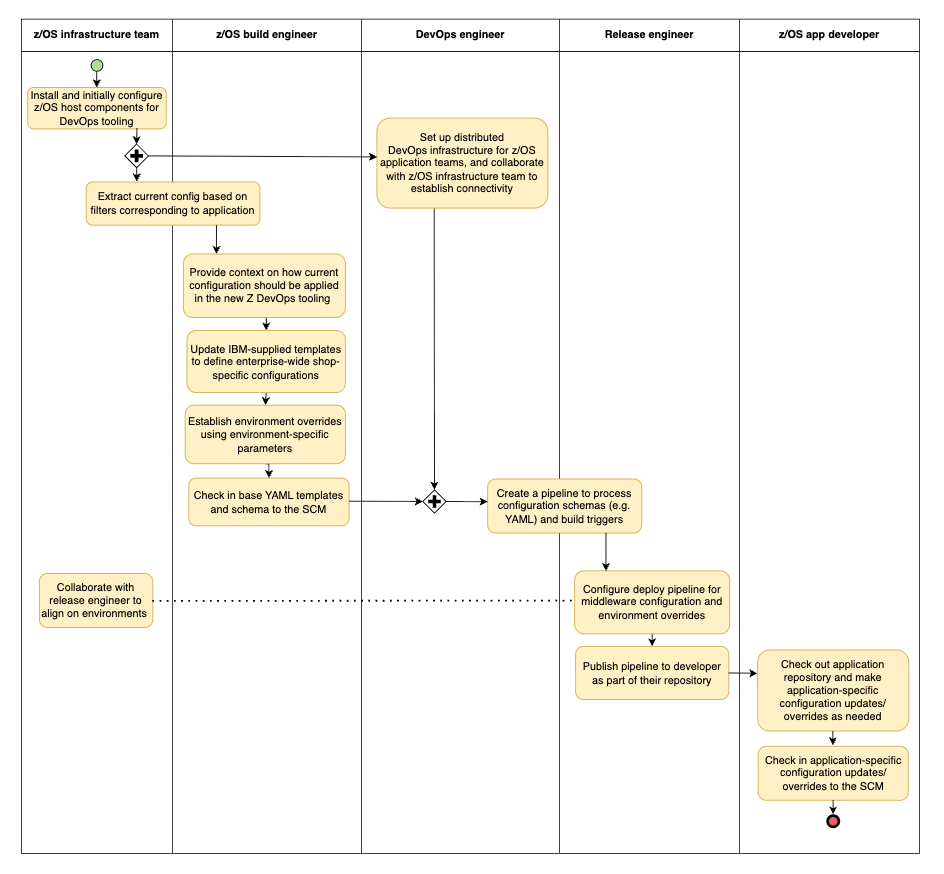
Once the DevOps tooling and CI/CD pipeline are set up, they can be used by various end user roles throughout the software development lifecycle, as outlined in Role-based usage.